Saturday, January 12, 2008

123. Chinchon

Our final stop for the day was the pretty market town of Chinchon. Its plaza mayor is really pretty, a bullring surrounded by centuries-old buildings lined with covered arcades. The buildings are all tilting precariously and the arcades are held up by columns that look like they're about to snap, but it's a pretty arrangement, ruined by the practicality that the bullring is a parking lot when the bulls aren't being slaughtered.


The gardens are enormous, much bigger than La Granja, but not as nicely designed. The palace is on the river, but the gardens couldn't be contained so there are bridges over the river allowing the garden to sprawl over the other bank. We walked for about an hour through the garden, but it soon started looking more like a nature reserve as the gardeners ran out of things to do with all this space.


Aranjuez is known throughout the country for two things, asparagus and strawberries, and Madrilenos flock here on weekends just for these. We stopped at a grand cafe outside the palace for lunch, and of course ordered asparagus and strawberries (separate courses), just like everybody else. Surprisingly the asparagus came from a can and the strawberries were frozen, so I didn't really see the point.


Aranjuez's interior wins hands down, however. You have to take a guided tour to see it, but it's a succession of wildly themed rooms. There are quite a few with a Moorish theme, several Asian themed rooms and a couple of really beautiful, intricately decorated porcelain rooms.


122. Aranjuez

Next stop was Aranjuez, another baroque palace built at the same time as yesterday's La Granja. It's quite similar in fact, probably because it was built by the same king and also modeled after Versailles. I liked La Granja better, mainly because Aranjuez was built of brick, which isn't really a palatial building material.


Toledo province is part of La Mancha, a vast plain made famous by Cervantes' Don Quixote, where the lead character famously attacks windmills which he mistook for evil giants. The white centuries old windmills are scattered about La Mancha, and still in use.


The town wasn't up to much. It was a fairly sprawling, whitewashed town, which looked more like the villages in Andalucia than around Madrid. As usual it was pretty empty, bar the occassional elderly black clad woman.


121. Orgaz

For our last day based in Madrid, we drove around the barren province of Toledo. Throughout the trip every time we left the big cities we were pretty much on our own, but I decided to try and really get off the tourist circuit by going to a place not even the guidebooks, Orgaz. And the lesson is that guidebooks are usually right. Orgaz has a castle, as you can see, which looks quite medieval. Its only problem is its marooned in the middle of the town, surrounded by a traffic circle, which is hardly atmospheric. Apparently it was owned by the Counts of Orgaz through the nineteenth century, then abandoned. It's still in quite good shape, which is strange because it's closed to visitors, uninhabited and as far as I can tell not used for anything.


120. Coca

On the way back to Madrid, we drove to Coca to see one last castle. To refresh your memories, we spent a day the previous week driving around Segovia province looking at castles, but the driver got lost and we weren't able to get to Coca. But this was supposed to be the best of the lot, so I made us take a long detour today to see it, despite the over-castled look in Somchai's eyes. It's an interesting variant on a castle given the heavy Moorish decorative influence, which is weird if you think about it since the Moors were the enemy the castle inhabitants were always fighting. The interior is supposed to be the most interesting of all the castles in the area, which isn't saying much, but in any event the staff decided to take a four hour lunch and hadn't returned by 5 pm, so we left. Interesting, but definitely not worth the detour.


Segovia's aqueduct is one of the most amazing sights in Spain. Built by the Romans two thousand years ago to carry water into the city, it's been doing so undisturbed by invasions or traffic ever since. When I came here in high school I was amazed to see cars driving through the arches, which I think could have allowed one drunk driver to topple the whole thing. Fortunately they've stopped that, although the aqueduct still seems remarkably fragile. So I recommend seeing it while it's still there, because it's probably my favorite Roman ruin outside Rome.


The church of San Martin is one of several Romanesque churches in the city. I made special mention of it in my journal so it must be nice, but I didn't mention why I mentioned it, so I don't have much to say about it.


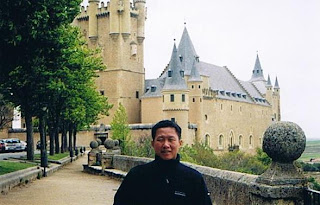
The Alcazar was built by the Moors, and substantially renovated by the conquering Christians. It sits at the very tip of the city, with sweeping views over the surrounding plains. It's pretty much a storybook picture of a castle, probably because in large part it came from a storybook. After Segovia ceased to have any military importance, the castle was converted into a military academy. In the nineteenth century, some bored cadets set fire to their school, hoping to burn it down so they could get transferred to Madrid. When the architects set about rebuilding the burned out parts of the castle, they tried to make it as fairy tale as possible, adding all kinds of turrets and towers, which was a good thing because it's now probably the most famous castle in Spain.


Unfortunately we weren't allowed inside because of the weather, which is odd, because the castle's survived everything except angry students for many centuries so it seems unlikely that it would dissolve in the rain. But anyway I remember from my high school trip that it's not that interesting anyway.



The Plaza Mayor is located in front of the cathedral, and is as expected a main meeting place for the locals, as well as the main eating place for tourists. We dined at an unexceptional cafe on the square with the rest of the (sparse) tourist crowd. As any foodie knows, Spain is the new France, the leader in culinary skill and inventiveness that grabs all the attention. And that's clearly true at the top spots. But Spain seems well behind France and Italy, and even England, in casual dining; in France and Italy for example you're virtually assured of a great meal anywhere, while Spain's mid-tier restaurants and cafes can be pretty awful.


After lunch we walked around the city's narrow streets until we eventually arrived at every tourist's second destination, the Alcazar.


The interior is fairly standard, huge but unadorned. The figures in the photo below are on top of various floats that are carried through the streets during Holy Week. These festivals in other parts of Spain are world famous like the running of the bulls or the tomato throwing craziness, but here's it's pretty staid.


We then entered the city and headed for the gargantuan cathedral, built in the sixteenth century with obvious Moorish influences. Because it's right in the center of the city it's almost impossible to get a photo of its outsized proportions although there's a side view from a distance pictured here (not ours) that takes in the massive bell tower as well.


We stopped first at my insistence at the Church of Vera Cruz down in the valley below Segovia. The church is an eleventh century church built by the Knights Templar, and is characteristically semi-round. I've had a fascination with the Knights Templar ever since I read Umberto Eco's Focault's Pendulum, and will always go out of my way to see a Templar church even though they're rarely interesting. I'm not sure why this book didn't spark a huge boom in Templar interest, as it's vastly superior to the silly Da Vinci Files, which basically rehashes the same plot as Focault's Pendulum. But since the Da Vinci book and movie I'm sure the lonely little Templar church is lonely no more.


There were some monasteries and convents in the general area as well, plus a mint where they converted the gold from the Latin American colonies into coins, but it's mostly ruins now, as you can see from the area around Somchai. The city of Segovia is draped along the hill behind him.


119. Segovia

We then moved on to the main event, the ancient city of Segovia. On my high school Spanish class trip I remember Segovia being the trip highlight, partly because of its location, a walled city with a fairytale castle and domineering cathedral perched high above the surrounding valley, and partly because we took a train here from Madrid, and I discovered that you could open the train doors while it was moving.


Segovia was a major city in Roman times, and the population at that time of 50,000 is about the same as the current city 2,000 years later. Ah, progress. It subsequently became a Visigoth and Moorish city, but achieved its current look when it was reconquered by the Christians of Castile in the twelfth century.


La Granja is most famous for its gardens, which cover hundreds of acres and have all sorts of walking paths, lakes and statues to entertain the court. The garden's highlight are the two hundred fountains all over the property, many of them hidden, which are only turned on one day a year. Thankfully it wasn't the day we were there or we may have had to swim back to Madrid.


Either because of the rain or because the region is filled with palaces and castles, we had this one all to ourselves. So we wandered through the twenty or so rooms open to the public with nothing but our echo to accompany us. The rooms were fancifully decorated in typical baroque excess, although the occupants either never sat down or slept, or somewhere along the line somebody swiped all the furniture.


118. La Granja

Tuesday was the worst weather day of the trip, dark skies and heavy outbursts of rain, but there were enough breaks in the rain to make the day salvageable. We headed north to Segovia, stopping first at another royal palace, at La Granja. By the 1700's Spain had ceased doing anything important like saving Europe's soul, and the ruling class could settle down and spend what was left of their riches on nice baubles and palaces rather than wars and inquisitions. Unlike the austere Escorial palace, La Granja is clearly a baroque building, modeled, like most palaces of the time, on Versailles.