Showing posts with label El Escorial. Show all posts

Saturday, December 1, 2007

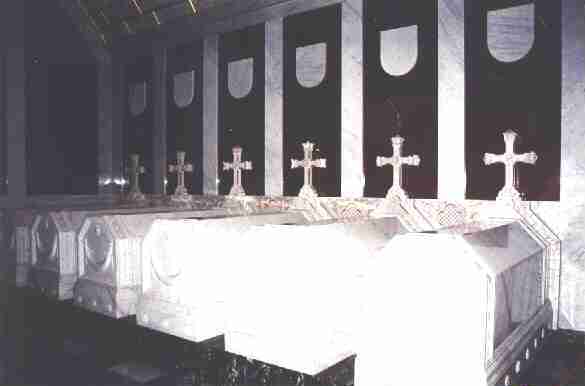
Felipe also designed El Escorial to serve as the burial chamber for the royal family, who previously were buried all around Spain in whatever cathedral caught their fancy. Almost all the kings and queens are buried in the green marble pantheon with the chandelier pictured here. He established an elaborate pecking order for the graves. Queens who married into the family (rather than being born into it) and who weren't mothers of future kings got separated from their husbands and were buried in the pictured room with the row of white marble coffins. There's also a huge birthday cake in the middle of one room (pictured) to house all the princes and princesses who died as babies, which is now a bit more than half full. And there are many more rooms for assorted royal relatives depending on their degrees of closeness to the throne.


A couple of photos of the basilica, which is decorated in typical over the top style. If you go back to the first post on El Escorial, which nobody will do, you'll see a huge dome jutting out of the middle of the complex. That is the basilica, which gives you a good idea of the size of the church, which dominates the secular parts of the complex. The basilica was designed by the architect of St Peter's in Rome, and shares many similar design elements, including a clear desire of both buildings to intimidate and awe visitors.


Wednesday, November 28, 2007

The interior is much more colorful, and chock full of famous artwork. The king established a world famous library at the complex, for use by the monks that lived there. It was supposed to be something like a research center against Protestantism, collecting all sorts of ancient religious volumes for the monks to use in their research. It fell into disuse shortly after construction however, as subsequent generations of monks were illiterate, but is now the most popular part of the complex. By the way, a big chunk of the palace is still used as a monastery, convent and school so much of it is off limits. Which is a good thing because what's left is pretty tiring.


I thought the most interesting part of the palace was the king's quarters, a couple of plain white rooms tacked onto the basilica. He didn't age well, and for much of his life was afflicted with a disease that rotted his body and caused him too smell so bad that nobody could approach him. So he stayed by himself in his room,with a window overlooking the basilica where he could hear the church services being conducted around the clock, every day of the year.


The complex was built as an enormous grid, with a huge amount of numerology and related fake science governing the building's construction. The grid pattern was supposed to be patterned after the long-lost Temple of Solomon in Jerusalem, as well as the griddle on which his favorite saint, Saint Lawrence, was roasted by the Romans. But there are all sorts of rules governing the number of windows, staircases, rooms, courtyards etc that you will learn in numbing detail on a guided tour.


We decided to skip the tour and explore for ourselves, which is a good idea, but the downside is that the place is absolutely massive and mazelike, and I'm sure we missed about half of it.


Construction started in 1564 and finished about twenty years later, in time for the king to receive the news that his famous navy, the Armada, was completely wiped out in his ill advised attempted invasion of England. Unlike the other palaces littered around Europe, this was always designed by the monklike king to be primarily a religious complex that happens to house the king and the advisors governing, or attempting to govern, most of Europe. This accounts for the austere architecture of the exterior, which complements the bleak surroundings.


114. El Escorial

On Friday the three musketeers (Brian, Somchai and Jose) headed west to Avila province, stopping first at El Escorial. Escorial is Spanish for slag heap, as the incredibly huge building was built on a slag heap (leftover crap from iron mining) in a desolate stretch of terrain. The location, and every other detail of the immense project, was chosen by King Felipe II, at the time the richest and most powerful man in the world. And why did he choose such a horrible location? Because he was crazy in a religious nut sort of way. He was king of Spain and Portugal, the Holy Roman Emperor controlling most of Germany, and the Emperor of Austria and occupied Holland, Belgium and Latin America. He ruled this vast empire from this spookily austere complex in the middle of nowhere. It took a couple decades to build, and was conceived as a palace, monastery, convent and religious school all wrapped up in one. Any money left over from building this place went to his perpetual wars conducted in his singlehanded attempt to wipe out Protestantism throughout Europe, which ended up being a gigantic waste of life and money.